Friday, June 4, 2010

Final Design

Images of the final design.


Thursday, June 3, 2010

Project Finished!

Here is an example video of how the shirt could be used:


The final details of our project can be found on Xanthe's blog.

Zig Zag Frills

I spent a long time sewing the ribbon zig zags onto the shirt and around the LEDs, but it was worth it! The LEDs are now nicely embedded into the design with the use of the ribbon and looks really good.

Pictures are on Xanthe's blog.

Saturday, May 29, 2010

Aesthetic part of Project

So Xanthe and I decided that we no longer want an over-layer as part of the top. Instead, we've decided to make the LEDs part of the design. We went to buy some decorative fabrics yesterday to stitch around the LEDs to make it look more aesthetically pleasing.

Friday, May 28, 2010

Coding

Today in class I asked Rohan to help me fix the minor kinks within our code. After cleaning up the code a bit, my problem was fixed. The code is now pretty much done. We only need to add the line of code that scales the flex sensor values that we figured out the other day and we're done with the code!

Monday, May 24, 2010

Slowly assembling our project

The bare bones of our project in development:

Flex Sensors Update

So I heard from Craig last night that he finally got our flex sensors and will be bringing them in to uni today. We'll finally be able to finish coding and start putting our project together! In the meantime, Xanthe has been soldering LEDs together and started hooking them up to the lilypad.

Saturday, May 22, 2010

Testing Light Through Fabric

Testing how well the lights will shine through the fabric:


Monday, May 17, 2010

More Coding...

I figured out how to activate a second LED after a certain amount of time with the help of Craig's coding skills. I also went ahead and added a third LED that starts to fade in and out after the second one has been on for a while. Here is a short video of how it works so far.


The basic coding for our project is done, but once our parts arrive, we'll be able to finish the code and properly start putting things together.

Thursday, May 13, 2010

Idea + Coding

The idea for our project is that if the wearer is slouching, subtle lights on the sleeves will start to light up and pulsate, indicating to the wearer to straighten their posture. If the wearer ignores this first sign and stays in the slouching position for a long amount of time, more LEDs will start to light up and pulsate, which would become more noticeable to the wearer.

Today I modified some code from my previous project to work with the flex sensor that Anne lent us. I managed to get an LED to fade in and out if the bend value is under 70. Small, but significant progress!

Tuesday, May 11, 2010

The Garment

We figured that for our project, we would have two layers of clothing; the under layer with all the circuitry stitched to it, and the over layer to hide all of the circuitry and diffuse the lights. The under layer would be a tight fit so that the flex sensors can pick up accurate values along the back. The over layer woud be a bit baggy so you can't see the bumps of the circuitry attatched to the inner layer.

Gathering Materials

Xanthe and I have talked about what materials we need in order to put together this project. We've told Craig to put us down for 4 flex sensors in the class order that he is organising from Sparkfun. Xanthe has ordered some LEDs from Farnell and we went shopping yesterday for some tops that we could use for this project.

Thursday, May 6, 2010

Brainstorming Ideas

Xanthe and I were brainstorming some more possible ideas for this project. In the end we came up with a posture correction shirt. When the wearer is slouching, they would get an indication, perhaps on the sleeve, to say that they are slouching, which would tell them that they need to correct their posture. We were thinking of using a flex sensor to get values from the arch of the back when slouching.

Monday, April 26, 2010

Video of Lady Luminance

Lady Luminance

Inspired by Lady Gaga’s outrageous fashions, Lady Luminance is at first glance, an elaborate headpiece, but when activated, becomes an interesting lightshow on the head. If one wanted to wow the crowd, Lady Luminance is the way to go.

Lady Luminance has a built in light sensor which determines how fast the lights flash. If worn in a well lit room, the lights will change and illuminate the flowers in the headpiece in a slow and subtle way. However, if worn in a dark room, the lights would cycle through quickly, which is when the real excitement begins. In the dark is where one can see the full beauty of this piece, with each flower glowing brightly and changing colours in a fast, pulsating way. It is a perfect accessory for costume or dance parties.


Saturday, April 24, 2010

FINISHED!!

So I've finally finished my headband! Here are some quick pictures of how it looks like. More high res pics will be taken later.

Saturday, April 17, 2010

Work in Progress

Wiring the LEDs onto the headband with conductive thread...


It works!

Tuesday, April 13, 2010

More code testing

So I went to uni today for the extra session to get help with my code. After talking with Anne, Doug and Rohan, I finally got my code working to how I wanted! Now all that's left is to test it out with multiple LEDs and assemble the whole thing.

Sunday, April 11, 2010

LED Testing 2

Coded the LEDs so that if there is low light, the LED's light pattern will cycle faster and when there is lots of light, it will cycle slower. It's not perfect yet but getting there...

Friday, April 9, 2010

The coding side of things...

I played around with Arduino today and after hours of being stuck at a dead end, I managed to figure out a few things. I have managed to make it so that when the light sensor has little light, the LED would fade in and out of red and when there is lots of light, it would fade in and out of green. I'm getting there!

Thursday, April 8, 2010

Luminosity Test

Testing out how well the material diffuses the light from LEDs.


It still diffuses nicely even with the paper as a frame.

Wednesday, April 7, 2010

Headband Work in Progress

Here are some pics of my headband in development:
I decided to make the flowers out of 2 different types of material to add some variation to the piece. I have chosen cotton and gauze material for the flowers because both these fabrics diffuse light in an interesting and different way.

Although manipulating the gauze material was simple enough, I initially had trouble folding origami roses with the white cloth since it is very flimsy and difficult to manipulate. However, I managed to find a way around it by folding the cloth with some paper to get a nice looking flower.

Sunday, April 4, 2010

Concept Inspiration

Inspired by Lady Gaga's outrageous head wear, I want to create a headband that is costume like, something that would not usually be worn on a typical day. I want to create a flower arrangement on the headband with an LED inside each flower, illuminating it. The flowers would glow in a certain light pattern depending on a light sensor.

Sunday, March 21, 2010

Project Two Concept Ideas

Glowing Headband - The LEDs react to a light sensor, so that whenever there is low light, the LEDs will pulsate bright colours. When there is lots of light, the LEDs will glow dimmer lights.


Equaliser Headphones - There will be LEDs on the headset and they flash like equalisers when music is playing through the headphones.


Friday, March 12, 2010

Bluetooth Watches

Image Source: http://c0378172.cdn.cloudfiles.rackspacecloud.com/10264_27100872540.jpg

This watch is a useful device which will detect your phone from up to 10 meters away. It is a bluetooth device that displays the caller ID and vibrates as your phone is ringing or when you receive an SMS. You can also accept or reject calls with it and has many other features too. It is a very handy piece of technology for if you leave your phone in another room or out of site.
More info here: http://www.gizmag.com/sony-ericsson-bluetooth-watches-women/10264/

‘Tele Scouter’ retinal-display translation glasses

 Image Source: http://c0378172.cdn.cloudfiles.rackspacecloud.com/nec-tele-scouter.jpg

This is a pretty nifty idea. The prototype device called a “Tele Scouter” translates the foreign language being spoken by a partner and projects the translation onto a tiny retinal display. When projected to the retina, the message appears as if it was displayed from 1 meter away.
More info here: http://www.gizmag.com/nec-tele-scouter/13227/

LED Tattoos

Image Source: http://c0378172.cdn.cloudfiles.rackspacecloud.com/silk-silicon-implant-2.jpg

I found this to be a really fascinating piece of technology. It is an LED tattoo, which is made of a thin film of silk on which silicon transistors about one millimeter long and 250 nanometers thick are placed. The silk holds the electronics in place and conforms to the biological tissue when implanted inside the body and wetted with saline. The silk substrates are then completely broken down by the body into harmless by-products. Because they are just nanometers thick, the thin silicon circuits left behind don’t cause irritation.
Illuminated tattoos! That sounds really cool!
More info here: http://www.gizmag.com/implantable-electronics/13334/

Japanese Wrist Phone

Image Source: http://www.geeky-gadgets.com/wp-content/uploads/2010/03/KDDI.jpg


Japanese phone maker KDDI has a new phone which is rather interesting. It basically monitors your movements and can tell when you're slacking off. The phone is worn on your wrist and uses an accelerometer to check your movements and compares them to the information stored on a server, which can then identify what you are doing.

Wednesday, March 10, 2010

Life Dress Presentation

Elizabeth Fuller is a university student at New York University, who is exploring wearable technology, web development and user interface. During her final year, she developed a project called the Life Dress, which is a dress that has LED lights which run on the Game of Life algorithm by created by a mathematician called John Conway.

I have chosen to present her Life Dress project to the class because I thought it looked really interesting and I really liked the design. It was recently presented at the Interactive Telecommunications Program (ITP) Show in New York, in December 2009, where it received lots of positive reviews.

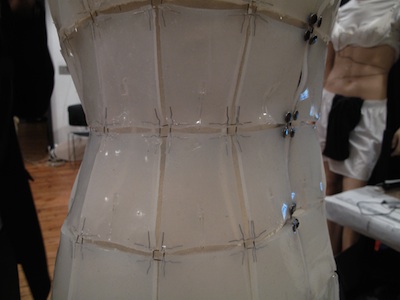
This dress consists of 3 inch tiles, each made of dragon skin silicon and are sewn together in a grid like formation. Embedded within each tile is an LED light, which glows through the translucent material. The form and light patterns of the dress was inspired by John Conway’s Game of Life algorithm, which determines whether each panel is either alive, which indicates the LEDs to turn on, or dead, indicating for the LEDs to turn off. If the cells in the game are all alone or if there are too many clumped together, they would die. Fuller relates this idea to people and how they should find the right level of interaction between the people in their lives in order to live a good life, thus calling her project the Life Dress. The constant changing of the light patterns also relates to our lives in the sense that our lives are also constantly changing and unpredictable. The Life Dress is a representation of our lives.

Fuller uses these simple rules to create an interesting and dynamic light show on the dress, which is a remapping of the 2D grid from the algorithm. The light of the LEDs is diffused by the tiles of dragon skin that the LEDs are embedded in, creating an aesthetically pleasing look. However, the dress is also slightly transparent due to the materials that she has used, which means that it has the potential for indecent exposure if one were to wear it with nothing underneath.

Although the use of silicon tiles might limit the wearability of this dress, her idea is a great concept, which could be further developed to create a garment with more conventional materials. This dress is still a prototype, and Fuller is currently working on creating a 2.0 version.

For more information on the process of this project, go to Elizabeth Fuller's blog here.

Friday, March 5, 2010

"Life Dress" By Elizabeth Fuller

Image Source: http://www.itp.efuller.net/images/_10spring/l_100124_2.jpg

Elizabeth Fuller is a university student at New York University, who is exploring wearable technology, web development and user interface.

I have chosen to present her Life Dress project to the class because I thought it looked really interesting and I really liked the design. It is made of dragon skin silicon tiles, which are sewn together, with LED lights within each tile, and the dress' light pattern changes according to the algorithm of John Conway's 'Game of Life.' The algorithm is a simple set of rules that determined weather each cell in a grid is either alive (on) or dead (off). All of the light patterns are powered by an arduino. The tiles form a grid and each tile lights up according to the rules of the algorithm.